

Two-Tier ERP with SAP S/4HANA Cloud
Digital transformation continues to influence changing business paradigms. To meet ever-increasing market demands and changing customer needs, businesses often have to scale up or expand operations. This can range from diversifying Lines of Business (LOB) to merges and acquisitions. This could involve adapting existing infrastructure to new LOB-related business process, integrating subsidiaries across various geographical locations into existing IT infrastructure or the integration of various disparate IT systems.
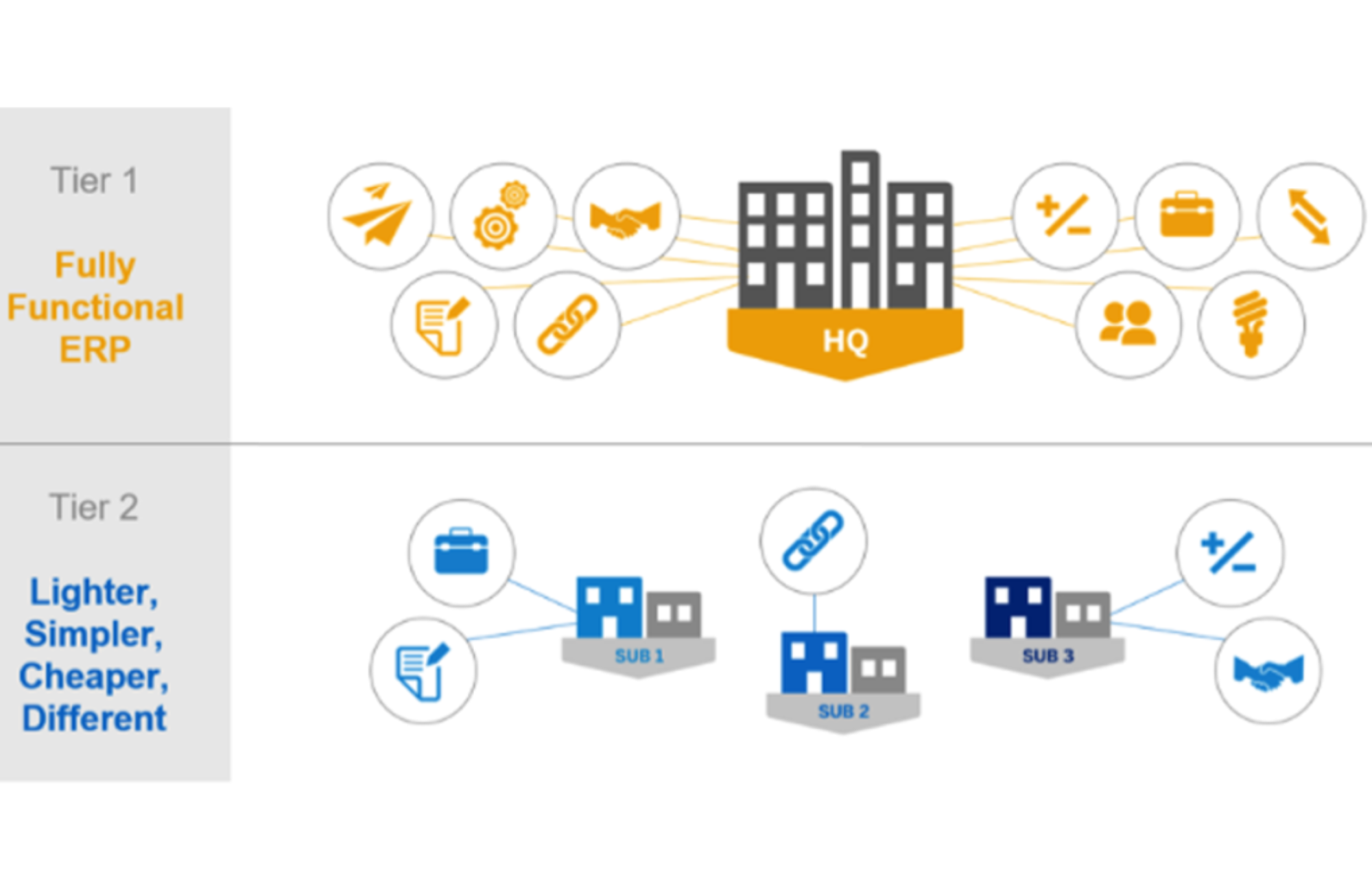
The two-tier ERP approach attempts to solve the IT business hurdles of expansion by seamlessly integrating multiple ERP landscapes. The methodology splits IT landscapes into two operating environments. The first tier is focused on traditional and stable areas of business processes requiring stability. The second tier is focused on innovation geared towards agile implementation. Subsidiaries often operate with varying degrees of autonomy and scale of operations. By following a decoupled approach, business can leverage diversity while still delivering consistency overall.
This approach has also been used to leverage an efficient cloud migration and minimise risk of disruption by decoupling on-premise and cloud landscapes. SAP S/4HANA promotes the use of public & private cloud services for businesses in their two-tier ERP. However, the conundrum is often felt in the consideration of a brownfield lift & shift vs a greenfield re-implementation. These options are discussed below.
SAP S/4HANA Private Cloud is a web-based ERP solution that does not support extensive customisation. By nature this service excludes brownfield developments. Software is managed by SAP as the cloud provider with system updates pushed automatically.
SAP S/4HANA Private Cloud is often the selected choice for companies that have high complexity needs such as manufacturing or pharmaceuticals. SAP also offers hybrid version that includes on-premise infrastructure, making it a popular business choice for hesitant customers needing to migrate. Software is managed by SAP as cloud provider but updates are scheduled with customer. Software modifications are allowed but often come with increased fees and need to adhere to guidelines.
Brownfield refers to existing infrastructure/developments. In this case existing ERP landscapes. Businesses wanting to migrate their existing frameworks would need to perform a lift and shit via SAP S/4HANA Private Cloud Hybrid. This would enable both on-premise and cloud infrastructure and is best suited to maintain the businesses existing state.
Regardless of the migration route chosen, it is clear that businesses need to evolve to remain relevant. Whether leveraging cloud, two-tier ERP or both, it is clear that decisive action is needed to navigate through digital transformation.
Sources:
- David Penny. Two Tier ERP and which SAP S/4HANA Cloud?. Available: https://www.linkedin.com/pulse/sap-s4hana-cloud-private-edition-customer-data-center-david-penny/.
- OpenSAP. Two-Tier ERP with SAP S/4HANA Cloud. Available: https://open.sap.com/courses/s4h9.
- Sven Dencken. Two-Tier ERP for SAP S/4HANA Cloud. Available:https://blogs.sap.com/2021/03/18/two-tier-erp-for-sap-s-4hana-cloud/.
- Ownen Pettiford. Understanding SAP Private Cloud, Public Cloud and On Premise – Important for S/4HANA Roadmap. Available: https://blogs.sap.com/2015/02/04/understanding-sap-private-cloud-public-cloud-and-on-premise-important-for-s4hana-roadmap/.